 Download slides
Industry braces for billion-dollar impact of engine recalls
Published: Thursday, December 11, 2025 | 09:00 AM CDT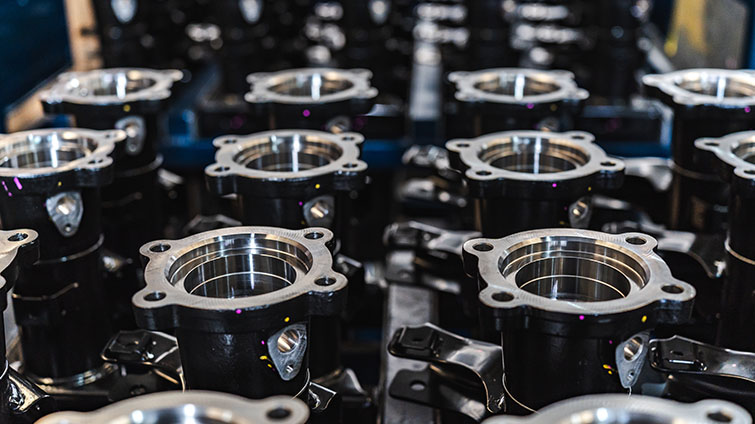
In an industry already struggling with tariffs and tepid consumer demand, the decades-long push for fuel-efficient engines has resulted in an unexpected consequence. Because older, larger engines were more tolerant of manufacturing imperfections than today’s more advanced ones, more than 5 million engines from five auto manufacturers are under recall or federal investigation as of December 2025. The auto industry is facing a predicted financial hit running into the billions.
Today’s engines, designed for low emissions and high fuel economy, run on thin oils, which make them intolerant of manufacturing byproducts such as tiny metal particles, called swarf. Older engines ran on thicker oil, which helps cushion and protect them against friction and contaminants.
Recalls on this scale would pose a significant logistics challenge. Working with an experienced provider that offers a full menu of expedited services allows automotive shippers to confidently manage expanded needs.
Humanoid robots: The new auto plant workers?
Automotive manufacturing has long used industrial robots. These were confined to performing highly specific repetitive tasks. Now, humanoid robots with some dexterity, cognitive learning and AI decision-making capabilities are entering factory floors.
Industry experts predict AI-powered humanoid robots will soon become an integral part of automotive manufacturing. They can work naturally with human workers, help manufacturers address labour shortages and perform tasks that were previously beyond the abilities of industrial robots—without the need for extensive programming.
Although full-bodied humanoids have mobility advantages, pilot programmes reveal that a bipedal robot is not always necessary. The upper body with humanoid arms and hands can be sufficient. At the same time, limitations remain to be solved, including greater dexterity, battery efficiency and decision-making during unpredictable situations.
The potential rise of humanoids will affect the automotive industry supply chain by adding critical inventory needs. Not only will manufacturers need automotive parts, they will also need to stock replacement parts for their humanoid robots.
The future of USMCA
Leading up to the first formal joint review of the U.S.-Mexico-Canada Free Trade Agreement (USMCA) in 2026, a public hearing took place 3-5 December, 2025, in Washington, D.C. The hearing focused on the agreement’s effectiveness and could lead to negotiations for an extension, amendments or something new. The USMCA’s 16-year term expires on 1 July, 2036, unless all three countries agree to extend it.
Changes to USMCA could have a major impact on the automotive industry due to the long-time integration of the supply chain across North America. Cross-border deliveries covered by USMCA are exempt from some U.S. tariffs but remain subject to tariffs on steel, aluminium, copper and items made with those materials.
As negotiations play out, automotive shippers can offset tariff costs with newly available freight consolidation services in Mexico.
For more insights, see the cross-border section of this report.
More stable U.S. trade policy creates optimisation window
Since mid-October, U.S. trade actions have shifted from escalation to stabilisation, creating a planning window for shippers. The tariff truce between the United States and China gives businesses time to solidify mitigation strategies and sourcing diversification. This can include nearshoring and friendshoring, for instance to other Asian countries or USMCA countries.
Meanwhile, the U.S. government has lowered tariffs on goods from South Korea to 15%, including tariffs on finished vehicles and auto parts. See the White House fact sheet and implementation details in the federal notice.
Key factors in the coming weeks and months:
Tariff authority court case
The U.S. Supreme Court’s decision on whether the administration has the right to levy tariffs under the International Emergency Economic Powers Act (IEEPA) is expected in December or January. This could end or reshape tariffs and lead to refunds. However, it is an open question how timely or robust these would be.
Section 232 risks
Importers should anticipate continued investigations and tariffs on materials and products deemed important to national security. Likely targets include critical minerals such as rare earths and semiconductor materials.
 Actionable freight insights